She Never Left the Airport: How One Woman Spent Nearly Two Decades Living in the Terminal
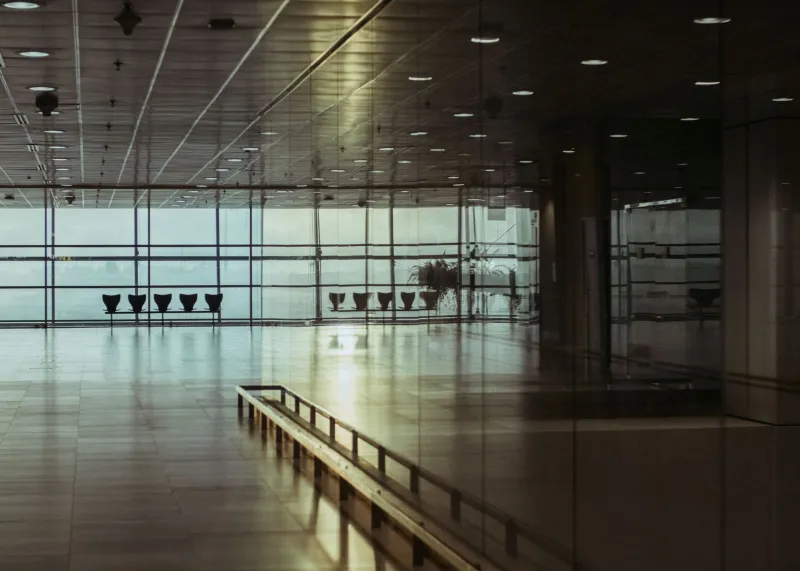
Airports are designed to be temporary. Every square foot of a terminal — the uncomfortable chairs, the overpriced sandwiches, the fluorescent lighting calibrated to make you feel vaguely unwell — is engineered around the assumption that you will leave. You will board your flight. You will pass through customs. You will exit through the arrivals hall and rejoin the world.
The system assumes movement. It has very little infrastructure for stillness.
Which is, in part, how a woman ended up living in one for the better part of two decades without the people responsible for noticing ever quite managing to do so.
The Trap Closes
The details of how she first became stranded vary depending on the source, but the broad outline is consistent: she arrived at a major international airport with documents that were either expired, contested, or insufficient for entry into her destination country. Immigration officials declined to admit her. She couldn't be immediately deported because her country of origin disputed her citizenship status — a bureaucratic limbo that sounds like a technicality until you realize it means no country on earth is legally obligated to take you.
She was placed in a holding area. The holding area became, by default, her address.
In the early period, authorities expected the situation to resolve itself quickly. Documentation disputes get sorted. Countries eventually accept their nationals. The paperwork catches up. Except in her case, it didn't. Days became weeks. Weeks became months. The officials who'd initially flagged her case rotated out, transferred, retired. The new ones inherited a file that had been open so long it had acquired a kind of institutional inertia — too complicated to resolve quickly, too minor to escalate aggressively.
So she stayed.
Life in the Secure Zone
What's remarkable — and what makes this story something other than simply a tale of bureaucratic failure — is how thoroughly she built a life within the terminal's constraints.
Airport employees brought her food. Some gave her money. She slept in a section of the terminal that saw little overnight traffic, eventually establishing what amounted to a small personal space: a chair she considered hers, storage for her belongings, a routine built around the rhythms of the airport day. She became, in the way that long-term residents of any institution do, part of the furniture — familiar enough that her presence stopped registering as unusual.
She learned to navigate the social ecosystem of the airport with precision. She knew which staff members were sympathetic, which shifts were lenient, which areas of the terminal were monitored less closely. She wasn't hiding, exactly. She was simply present in a way that the systems around her weren't designed to process.
Passengers occasionally struck up conversations with her. Some gave her books, cash, food. A few, learning her situation, tried to advocate on her behalf — writing letters, contacting embassies, raising the case with airport management. These efforts produced meetings, promises, and renewed attention to her file. None of them produced a resolution.
The Legal Architecture of Nowhere
To understand how this was possible, you have to understand what an international airport terminal actually is, legally speaking.
The secure zone of an international airport — the area beyond passport control — occupies a peculiar legal status. In most countries, it is technically not considered national territory for immigration purposes. You haven't entered the country. You're in a kind of jurisdictional buffer zone, present but not admitted, subject to the airport's rules but not fully subject to the country's immigration law in the normal sense.
This creates gaps. A person who cannot be admitted and cannot be deported exists in a space that the law acknowledges but doesn't quite know what to do with. There are international conventions that apply — the 1951 Refugee Convention, various statutes governing stateless persons — but enforcement is uneven, and the practical mechanics of resolving a case like hers require coordination between multiple governments, none of whom have a strong incentive to move quickly.
Airport authorities, meanwhile, are not immigration courts. They can flag a situation. They can refer it upward. What they cannot do, in most legal frameworks, is simply make a unilateral decision to admit or expel someone whose status is genuinely contested.
So the file sat. And she stayed.
How It Finally Ended
The resolution, when it came, arrived not through any dramatic legal breakthrough but through the accumulation of sustained outside pressure — journalists, human rights organizations, and advocates who kept the case alive in the public record long enough that ignoring it became more trouble than resolving it.
A country eventually agreed to accept her. The documentation was processed. She walked out of the terminal through the arrivals hall, into a world she had watched through windows and read about in newspapers for the better part of two decades.
She was disoriented by ordinary things. The scale of open space. The absence of the ambient noise she'd slept beside for eighteen years. The experience of being somewhere that wasn't, by definition, a place you pass through.
What the Airport Didn't See
The instinct, hearing this story, is to look for the villain — the official who dropped the ball, the bureaucracy that failed her, the system that let it happen. And those things are real. The case represents a genuine and documented failure of the international frameworks designed to prevent exactly this kind of limbo.
But the stranger truth is that no single person was responsible. The system didn't fail through malice or even negligence in the traditional sense. It failed because it was designed around assumptions — that people move through airports, that documentation disputes resolve within a predictable timeframe, that someone is always clearly responsible for any given person's status — that her case quietly invalidated.
She fell through a gap that the architects of the system had never thought to close, because the gap was so specific, so unlikely, that closing it hadn't seemed necessary.
Airports are built for passengers. They have very little to offer someone who simply never becomes one.