One Man, Two Territories, Zero Clues: The Post-Civil War Paperwork Disaster That Created America's Accidental Double Governor

One Man, Two Territories, Zero Clues: The Post-Civil War Paperwork Disaster That Created America's Accidental Double Governor
There are bureaucratic mix-ups, and then there are the kind that make you wonder how a country survives its own paperwork. The post-Civil War federal government was, by almost any measure, a spectacular mess. Washington was simultaneously trying to reconstruct the South, manage westward expansion, absorb thousands of new federal employees, and run a territorial government system that stretched from the Gulf Coast to the Pacific. Mistakes were inevitable. Most of them were small. One of them was not.
Somewhere in the mid-1860s, a clerical error in the Department of the Interior resulted in a single presidentially appointed official being legally designated the acting governor of two separate American territories at the same time. Not one after the other. At the same time. And for nearly three months, both territories went about their business under the assumption that Washington knew exactly what it was doing.
It did not.
How Washington Made Governing Look Easy (It Wasn't)
To understand how this happened, you have to appreciate just how chaotic territorial administration was during this period. The federal government managed a patchwork of territories across the West and South, each requiring an appointed governor, a secretary, a handful of judges, and a small bureaucratic staff. These appointments flowed through the Interior Department, which was also managing land grants, Indian affairs, patents, and the census — all simultaneously, all with a workforce that would look laughably small by modern standards.
Appointments were made on paper, confirmed through correspondence, and communicated to territories via mail that could take weeks to arrive. There was no central database. There was barely a reliable filing system. Clerks worked from handwritten ledgers, and when a name appeared twice in different columns, or a commission document got copied with a different territory listed at the top, there was no automatic check to catch it.
The specific error that created America's accidental double governor appears to have been exactly this kind of duplication. A commission document — the official paperwork granting an appointed official his legal authority — was prepared for one territory, then copied or reissued with a second territory's name substituted at the heading. Both versions were signed, sealed, and dispatched. Both arrived at their respective territorial capitals. Both were treated as legitimate.
The Man Who Didn't Know He Ran Two Places
The official at the center of this was an acting governor, a placeholder appointment common during the era. These were often political loyalists, former military officers, or well-connected party figures who needed a posting. They weren't always deeply engaged with the territories they nominally ran. Correspondence moved slowly. Day-to-day governance was largely handled by local officials and territorial legislatures. An acting governor's primary job was to sign documents, report to Washington, and not embarrass the administration.
In this case, the man holding both commissions appears to have been stationed in or near one territory, actively corresponding with Washington on its behalf, while the second territory — hundreds of miles away — was operating under the assumption that he was their legitimate executive authority too. Local officials in the second territory were making decisions, passing legislation, and sending dispatches to Washington addressed to a man who had no idea he was supposed to be in charge of them.
For roughly three months, this arrangement held. The first territory functioned normally. The second territory functioned normally. Washington received correspondence from both. Nobody flagged the overlap, because nobody was looking for it.
The Quiet Untangling
What finally broke the spell appears to have been a scheduling conflict — the kind of mundane administrative collision that exposes larger disasters. When both territories requested the governor's physical presence for separate official functions within a short window of time, someone in the Interior Department had to figure out which invitation to decline. That required looking up the governor's actual commission. Then looking up the other territory's commission. Then a very uncomfortable moment of realization.
The fix, when it came, was swift and silent. A new commission was issued for the second territory, naming a different official. The original error was buried in correspondence files. No public announcement was made. No congressional inquiry was launched. The territorial press in both locations apparently never learned that their executive authority had been, for a brief and genuinely bizarre period, legally shared between two places that had nothing to do with each other.
Federal bureaucracies have always had a talent for quietly absorbing their own failures, and this one was no exception. The paperwork got corrected. The ledgers got updated. And the whole episode slid into the vast archive of things that happened in 19th-century Washington that nobody was particularly eager to document.
What This Actually Tells Us
It would be easy to treat this as a punchline — and honestly, it is kind of a punchline. One man, two territories, three months of nobody noticing. That's genuinely funny.
But it also reveals something real about how the American West was actually governed during this period. The mythology of westward expansion tends to run toward grand destiny and deliberate nation-building. The reality included a lot of overworked clerks, unreliable mail, and systems that were making it up as they went along. Territories were being added to the map faster than Washington could build the administrative infrastructure to manage them. The miracle isn't that errors like this happened. The miracle is that the whole enterprise held together at all.
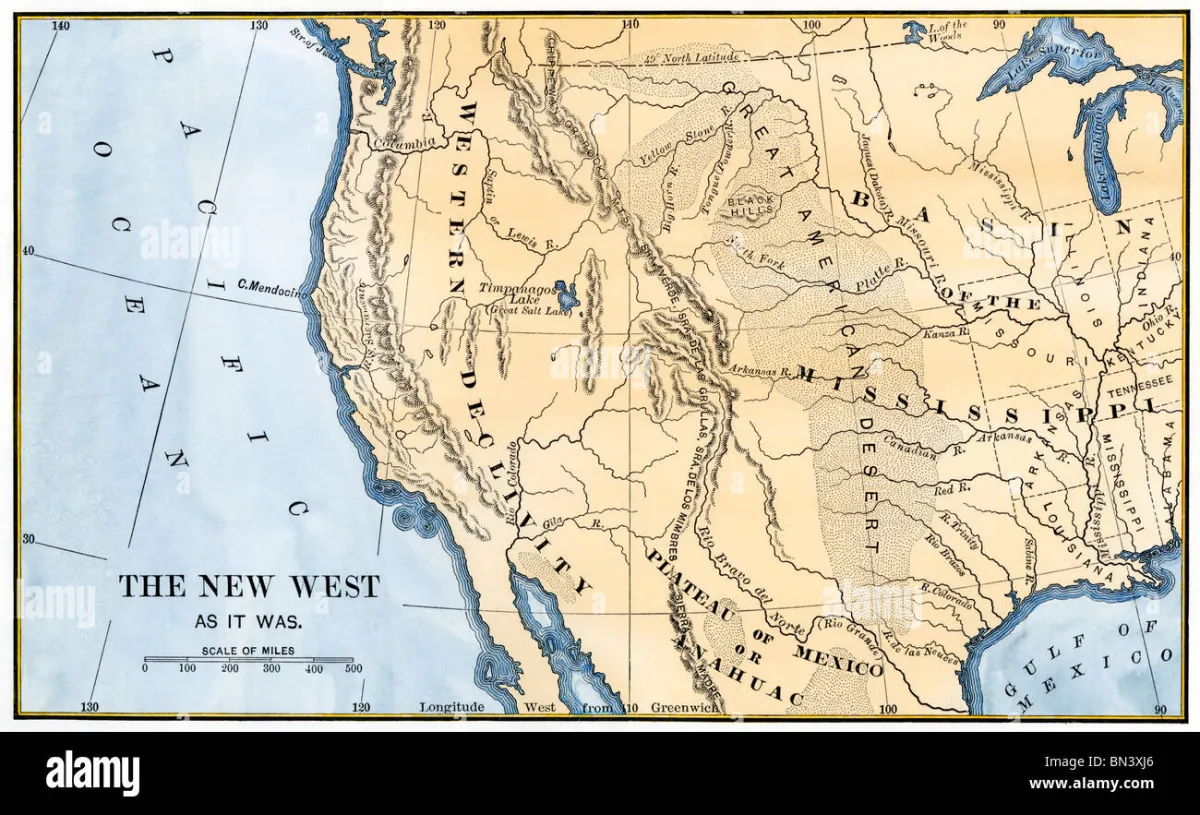 Photo: the American West, via c8.alamy.com
And somewhere in a federal archive, if the documents survived, there are two official commissions with the same man's name at the top and two different territories listed below — the most boring-looking proof of one of American history's most quietly absurd governing disasters.