The Punch That Changed History
On a frigid February night in 1894, two men who had never met before got into a heated argument at Murphy's Saloon in Butte, Montana. By the time the dust settled from their drunken brawl, they had accidentally triggered a series of events that would resolve one of the longest-running territorial disputes in the American West.
Neither man had any idea what they had set in motion.
Thirty Years of Conflict
The dispute dated back to the 1860s, when the federal government's hasty treaty-making had created overlapping land claims between the Crow and Northern Cheyenne tribes in southeastern Montana. Both groups had legitimate historical claims to the same hunting grounds along the Powder River, and both had signed separate treaties with Washington that seemed to grant them exclusive rights to the territory.
For three decades, the conflict had simmered. Hunting parties from both tribes would encounter each other in the disputed territory, leading to tense standoffs and occasional violence. Federal Indian agents had attempted to mediate the dispute repeatedly, but each negotiation session ended in deadlock.
The problem was that both tribes had strong legal arguments. The Crow could point to their 1851 treaty at Fort Laramie, while the Northern Cheyenne referenced their 1868 agreement. Meanwhile, white settlers were increasingly moving into the area, complicating matters further.
The Unlikely Participants
The two men who started the fateful barroom fight couldn't have been more different. Thomas "Red" McKenna was a Irish immigrant who worked as a clerk for the Bureau of Indian Affairs, though he spent more time drinking than filing paperwork. Joseph Standing Bear was a Northern Cheyenne who had come to Butte to sell horses and had stopped at Murphy's Saloon to warm up before the long ride home.
According to witnesses, the argument started over a poker game. McKenna accused Standing Bear of cheating, Standing Bear took offense at the accusation, and within minutes they were throwing punches across the saloon floor.
What made this particular fight significant wasn't the violence—bar brawls were common in 1890s Butte. It was what happened when the town sheriff arrived to break it up.
The Bureaucratic Mix-Up
Sheriff Patrick O'Malley was dealing with two drunk and belligerent men who were shouting at each other in a mixture of English and Cheyenne. In his haste to sort out the situation, O'Malley made a critical error: he assumed that McKenna, the white man, was the aggressor and Standing Bear, the Native American, was the victim.
This might seem like an unusual assumption for the 1890s, but O'Malley had recently been lectured by federal marshals about treating Native Americans fairly in his jurisdiction. Eager to demonstrate his compliance with federal guidelines, he arrested McKenna and released Standing Bear with an apology.
The problem was that McKenna, despite being a low-level clerk, technically held federal authority as a Bureau of Indian Affairs employee. His arrest by local law enforcement created an immediate jurisdictional conflict.
The Legal Domino Effect
When news of McKenna's arrest reached the regional BIA office in Helena, bureaucrats panicked. A federal employee had been detained by local authorities while "conducting official business" with a Native American. Never mind that the "official business" was actually a drunken poker game—the paperwork didn't specify that detail.
The Helena office sent an urgent telegram to Washington, describing the incident as a potential violation of federal sovereignty. They demanded that McKenna be released immediately and that any "agreements" he had made with Standing Bear be officially recognized.
The problem was that there were no agreements. But Standing Bear, nursing a hangover and confused by the sudden attention from federal officials, mentioned that he and McKenna had been discussing land boundaries during their conversation at the saloon.
This was true, in a sense. During their poker game, McKenna had drunkenly boasted about his knowledge of tribal territories, and Standing Bear had corrected him about which lands belonged to which tribes. It was bar talk, not diplomacy—but federal officials interpreted it as an official negotiation.
The Accidental Peace Process
Within weeks, the incident had been transformed by bureaucratic confusion into something resembling an official treaty negotiation. Federal agents arrived in Butte to "formalize the agreements" that McKenna and Standing Bear had supposedly reached.
Standing Bear found himself representing not just himself, but somehow speaking for Northern Cheyenne interests in the land dispute. McKenna, meanwhile, was suddenly treated as an expert negotiator rather than a drunk clerk.
The federal agents, eager to resolve the long-standing territorial conflict, began drafting documents based on what they thought the two men had discussed. They brought in Crow representatives to participate in what was now being called "the Butte negotiations."
The Unintended Resolution
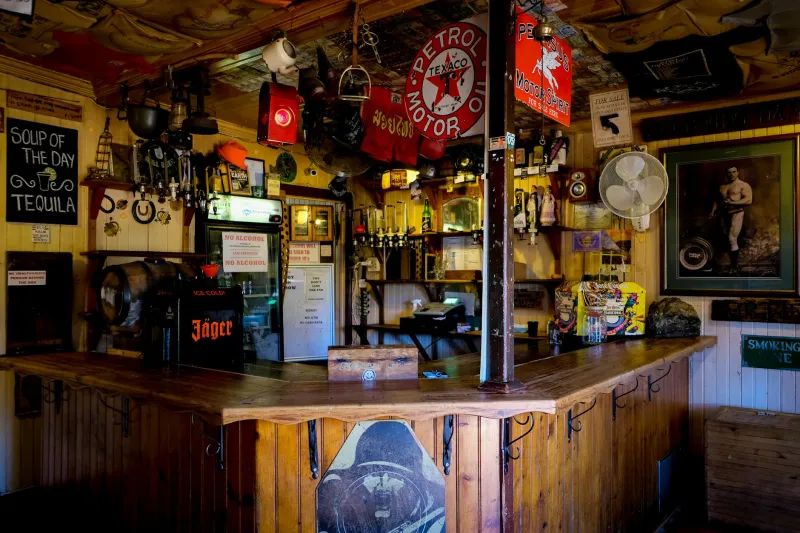
What followed was perhaps the most informal treaty negotiation in American history. The discussions took place not in government offices, but in the back room of Murphy's Saloon, where the original fight had occurred.
Standing Bear, still bewildered by the situation, found himself in conversation with Crow representatives who were equally confused about how a bar fight had turned into a peace conference. But something unexpected happened during these talks: both sides began to see a way forward that had eluded formal diplomacy for decades.
The key breakthrough came when Standing Bear mentioned that his tribe was more interested in winter hunting grounds than summer territory, while the Crow representatives indicated their priority was protecting their sacred sites and summer camps. Previous negotiations had assumed both tribes wanted exactly the same land, but the informal setting revealed they actually had complementary rather than competing needs.
The Murphy's Saloon Accord
On March 15, 1894, representatives from both tribes signed what became known as the Murphy's Saloon Accord—though official documents carefully referred to it as "the Butte Territory Agreement." The pact divided the disputed lands based on seasonal use patterns rather than permanent boundaries, allowing both tribes to maintain their traditional practices without conflict.
The agreement worked because it addressed the actual needs of both communities rather than the abstract legal principles that had dominated previous negotiations. The Crow maintained control of their sacred sites and summer hunting grounds, while the Northern Cheyenne gained access to winter territories that were crucial for their survival during harsh Montana winters.
Thomas McKenna received an official commendation for his "innovative approach to inter-tribal mediation," though he privately admitted he had no idea what he had done to deserve it. Joseph Standing Bear became a respected leader in his community, partly due to his role in resolving the long-standing territorial dispute.
A Discovery Hidden in History
The true story of how the Murphy's Saloon Accord came about remained buried in federal archives until 1987, when historian Dr. Margaret Thornton was researching territorial disputes for her doctoral dissertation. She noticed discrepancies between official accounts of the negotiations and contemporary newspaper reports of a bar fight involving the same participants.
Dr. Thornton's investigation revealed that one of the most successful Native American treaties of the late 19th century had originated not from careful diplomacy, but from a case of mistaken identity following a drunken brawl.
Lessons from an Unlikely Peace
The Murphy's Saloon Accord remained in effect until both tribes were relocated to reservations in the early 1900s. During its decade of operation, it successfully prevented the territorial conflicts that had plagued the region for thirty years.
Modern conflict resolution experts study the case as an example of how informal settings can sometimes achieve breakthroughs that formal negotiations cannot. The relaxed atmosphere of the saloon, combined with the absence of rigid diplomatic protocols, allowed both sides to focus on practical solutions rather than legal precedents.
The story serves as a reminder that some of history's most important agreements were never intended to be agreements at all—they just happened when the right people found themselves in the right place at the right time, even if that place was the scene of a barroom brawl.