Before the Jukebox, Before the Record Player, One Man Built an Orchestra Out of Gears and Brass
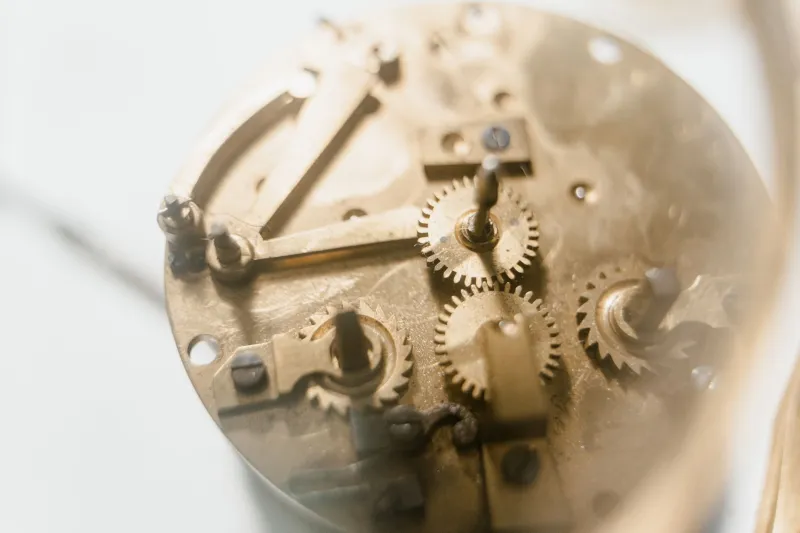
Picture a concert hall in 1924. The lights dim. The audience settles. The curtain rises — and there are no musicians. No conductor raising a baton. No string section tuning up, no horn players clearing their valves. Just an enormous machine, roughly the size of a city bus, humming quietly to itself before it launches into a flawless performance of Beethoven's Fifth.
The audience didn't know whether to applaud or run.
This actually happened. And the man who built that machine has been almost entirely forgotten.
The Engineer Nobody Talks About
His name was Edmund Farwell Crick, and almost everything about his biography reads like something a novelist would invent and then decide was too implausible to publish. Born in 1871 in Dayton, Ohio — the same city that produced the Wright Brothers, which feels appropriate — Crick had no formal engineering training. He taught himself mechanics through library books and correspondence with European clockmakers. By his early thirties, he was building elaborate automata: mechanical birds that sang, clockwork animals that walked, self-playing keyboard instruments that went far beyond anything a standard player piano could manage.
But those were warm-up acts. What Crick actually wanted to build was an entire orchestra.
Not a machine that approximated orchestral music. An actual mechanical orchestra, capable of producing the full tonal range of strings, brass, woodwinds, and percussion — simultaneously, in real time, without pre-recorded sound of any kind.
It took him nineteen years.
How You Build an Orchestra Out of Metal
The engineering challenge was almost incomprehensible by the standards of the era. Recorded music existed in a primitive form by the early 1900s, but the quality was poor and the technology was understood to be a novelty rather than a replacement for live performance. What Crick was attempting was something entirely different: not capturing sound, but mechanically generating it.
His solution was a hybrid system he called, in his private notebooks, the Resonant Engine — though he marketed it publicly under the considerably grander name the Symphonic Automaton. The machine used a combination of rotating brass reeds, tensioned wire arrays, and a series of pneumatic bellows to produce sounds that closely mimicked orchestral instruments. The entire system was controlled by a master cylinder — essentially an enormous music box drum, about six feet in diameter — that had been hand-engraved with the full notation of whatever piece the machine was set to perform.
Changing the piece meant swapping the cylinder. Crick eventually built twelve of them, covering works by Beethoven, Brahms, Tchaikovsky, and one original composition he wrote himself, which he described in his notes as "a waltz for a machine that has never danced."
The sound, by all contemporary accounts, was extraordinary. Not perfect — reviewers noted that the strings in particular had a slightly metallic quality — but close enough to the real thing that audiences who heard it without being told what they were listening to often couldn't identify the source.
The World's Fair Moment
Crick debuted the Symphonic Automaton at a regional exposition in Cincinnati in 1921, where it caused enough of a sensation that he was invited to display it at larger venues. Over the following three years, the machine appeared at exhibitions in Chicago, Philadelphia, and St. Louis. Press coverage was enthusiastic, occasionally breathless. A 1923 article in a Chicago paper called it "the most remarkable mechanical achievement of the modern age" and suggested it would "render the professional musician obsolete within a generation."
That prediction did not pan out. But the machine itself was genuinely celebrated — for a while.
Musicians' unions hated it, which was predictable. More damaging was the attitude of the recording industry, which was just beginning to understand its own commercial potential and had no interest in a competing technology that couldn't be easily reproduced or sold. Crick received no significant investment, no corporate backing, and no institutional support from any university or research organization.
He funded the whole enterprise himself, through a combination of exhibition fees and a modest inheritance. By 1926, the money was running out.
The Disappearance
Crick died in February 1928, at the age of fifty-six, from pneumonia. He was unmarried, had no children, and left no clear instructions about what should happen to the Symphonic Automaton or his twelve music cylinders.
What happened next is where the story gets genuinely strange.
His estate was managed by a distant cousin in Kentucky who had apparently never seen the machine and had no idea what it was worth. The Automaton was appraised along with the rest of Crick's workshop contents and sold as scrap metal — all of it, cylinders included — to a salvage dealer in Dayton for thirty-eight dollars.
Thirty-eight dollars.
The salvage dealer's records from that period no longer exist. The machine was almost certainly melted down within months. No photographs of the full apparatus survive, only a few partial images taken at the Cincinnati exposition showing the machine from a distance. Crick's notebooks — the ones that described the engineering in detail — turned up briefly at an estate sale in 1971, where they were purchased by a collector who died before cataloging them. Their current location is unknown.
Why It Matters That We Forgot
Music historians who have stumbled onto Crick's story tend to react with a combination of fascination and frustration. The Symphonic Automaton predated practical recorded music by decades and represented a completely different solution to the same problem: how do you bring orchestral music to people who can't afford concert tickets or don't live near a concert hall?
Crick's answer was mechanical. The recording industry's answer was electromagnetic. One of those answers won, obviously, and the other one got melted down for scrap.
But there's something quietly remarkable about a self-taught tinkerer from Dayton spending nineteen years building something that shouldn't have been possible, touring it around the country to stunned audiences, and then watching it disappear into a salvage yard because nobody thought to preserve it.
Somewhere in a landfill, or dissolved into some other machine entirely, are the gears and brass reeds of an orchestra that played itself. It performed Beethoven in 1924 without a single human hand on an instrument.
Nobody recorded it. Of course nobody recorded it.