Three Men Walked Into a Lighthouse. None of Them Ever Walked Out.
There's a version of this story that ends with a logical explanation. A rogue wave, maybe. A tragic accident on the rocks. Something clean and final that lets you close the book and move on.
That version doesn't exist.
What actually happened on the Flannan Isles in December 1900 is the kind of thing that makes investigators, historians, and armchair detectives lose sleep — because the evidence doesn't add up to anything. It just sits there, silent and strange, daring you to make sense of it.
The Most Remote Job in Scotland
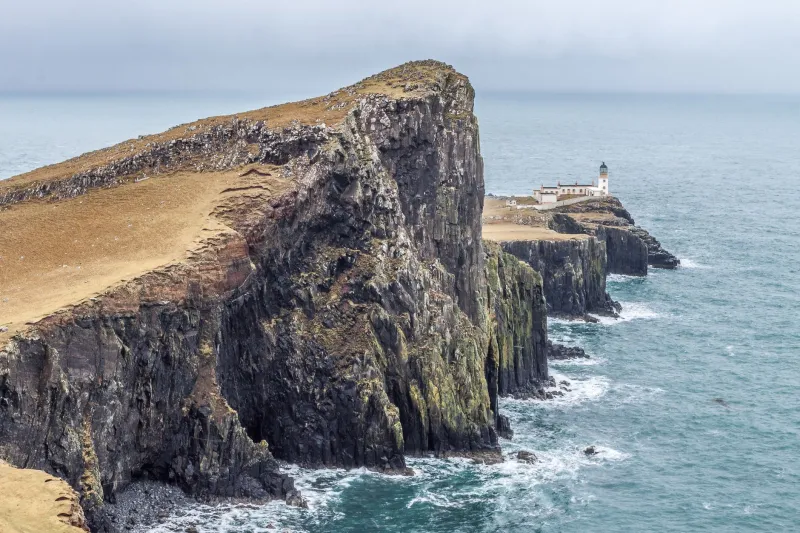
The Flannan Isles are a cluster of small, wind-battered rocks sitting about 20 miles west of the Outer Hebrides off the Scottish coast. They're not charming. They're not scenic in any postcard sense. They're the kind of place where the ocean doesn't ask permission before doing whatever it wants.
The lighthouse on Eilean Mòr, the largest of the islands, had only been operational since 1899. It was a new posting, and by December 1900, three men were stationed there: James Ducat, the head keeper; Thomas Marshall, his assistant; and Donald MacArthur, a relief keeper filling in temporarily. All three were experienced. All three knew the sea.
On December 15th, a passing steamer noticed something unusual: the lighthouse beam wasn't rotating. For a working lighthouse, that's essentially the equivalent of a hospital's heart monitor going flat. The ship's crew logged the concern and moved on. Nobody could investigate until a relief vessel arrived.
That vessel, the Hesperus, pulled up to Eilean Mòr on December 26th.
What the Relief Crew Found
The island was completely silent.
No one came down to greet the boat, which was already strange — lighthouse keepers lived for the arrival of relief ships. They were lifelines to the mainland, to news, to human contact. You didn't ignore them.
When crew members climbed up to the lighthouse, they found the front door unlocked. The lamp was cold. The clock had stopped. Two of the three waterproof oilskin coats — the kind you'd never leave behind in a Scottish coastal storm — were still hanging on their hooks.
In the kitchen, there was a half-eaten meal on the table. A chair had been knocked over and left that way. The log entries stopped abruptly on December 15th, with the last notation describing a severe storm and unusual distress among the keepers.
Ducat and Marshall, the log suggested, had been crying. That detail alone is unsettling. These were hardened lighthouse men. They'd seen storms before.
No bodies. No wreckage. No note. Nothing to indicate where three grown men had gone on an island with nowhere to go.
The Theories That Don't Quite Hold
The official inquiry, led by the Northern Lighthouse Board, concluded that a freak wave had likely swept all three men off the island's western cliff during an inspection. It was a tidy conclusion. It was also almost certainly incomplete.
Here's the problem: the storm described in the log doesn't match any meteorological records from the mainland. Observers in nearby areas reported calm conditions around December 15th. If there was a wave violent enough to take three men simultaneously, it left no corroborating trace.
Other theories have accumulated over the decades. Some researchers have pointed to an argument between the men that escalated fatally, though the logistics of that scenario — three experienced professionals, no weapons found, no blood — don't really work. Others have suggested that MacArthur, the temporary keeper, panicked during a perceived emergency and ran for the cliffs, with the others chasing him.
There's even a version involving a waterspout — a tornado-like column of water — forming suddenly over the island and pulling the men into the sea. Dramatic, yes. Documented, no.
And then there are the theories that live at the other end of the spectrum entirely: mass hallucination, mysterious illness, something stranger still. These exist mostly in folk songs and ghost tours, but they've never fully gone away, which tells you something about how unsatisfying the rational explanations feel.
Why This Case Still Haunts People
What makes the Flannan Isles disappearance different from other cold cases is the specificity of the strangeness. It's not that the men vanished and left nothing behind. It's that they left just enough — an overturned chair, a stopped clock, a meal nobody finished — to suggest that something interrupted ordinary life in a single, decisive moment.
The half-eaten meal detail, in particular, has lodged itself in the public imagination for over a century. It implies urgency. It implies that whatever happened, happened fast. It implies that someone sat down to eat and then, for reasons we'll never fully know, didn't.
The Flannan Isles lighthouse is still operational today, now fully automated. No human keeper has been required since the 1970s. Whether that's a coincidence or a reasonable institutional response to what happened in 1900 depends on how seriously you take the story.
Either way, the light keeps turning. The island keeps its secret. And three men who clocked in for a routine shift on a Tuesday in December remain, officially and permanently, unaccounted for.